
Constantin Brâncuși: the moment sculpture became essence
In the history of Romanian art, Constantin Brâncuși represents not just a central figure, but a turning point. After him, the language of sculpture could no longer remain the same. In the history of international modern art, his name is associated with a structural transformation: the transition from descriptive modeling to form reduced to principle. As art historian Sidney Geist observed in his fundamental study of the artist, Brâncuși did not simplify form to make it decorative, but to reveal its inner structure.

To understand this mutation, it is essential to look at his formative stage. Brâncuși attended the School of Arts and Crafts in Craiova, where he acquired a solid technical discipline, and then the National School of Fine Arts in Bucharest (1898–1902), where he studied sculpture academically. His graduation work, Ecorșeu (1902), created in collaboration with Dr. Dimitrie Gerota, demonstrates an exact knowledge of human anatomy and was subsequently used as teaching material in medical university settings. This stage is fundamental: Brâncuși perfectly mastered anatomy and traditional modeling before deciding to reduce form to its essence. Simplification was not a shortcut, but a conceptual choice.

His first public works, such as the bust of General Carol Davila, maintain the figurative rigor of academism, but in them one can already intuit a tension towards the concentration of volume. The artist seeks an internal order of form, a structural stability that will later become essential.

In 1904, his departure for Paris marked the beginning of a decisive break. Brâncuși walked much of the way, crossed Central Europe, worked to support his journey, and arrived in Paris in 1905. This biographical episode has often been interpreted symbolically, but beyond the narrative aura remains the reality of extraordinary determination: the artist chose the center of European art and entered directly into the avant-garde circuit.
In 1907, he worked briefly in Auguste Rodin's studio. The relationship with Rodin is essential, but the break is equally important. The retort attributed to Brâncuși — "Nothing grows in the shadow of great oaks" — is recorded in memoir literature and expresses his desire for artistic autonomy. Leaving Rodin's studio was not an act of defiance, but an act of asserting his own direction.

Auguste Rodin and Constantin Brâncuși. Source - Gandul.ro
At this point, the true formal revolution begins. While artists like Pablo Picasso were experimenting with decomposing the figure in painting, Brâncuși made a different move: he did not fragment form, but concentrated it. He progressively eliminated detail until only the essential structure remained. His sculptures do not describe surfaces, do not dramatize anatomies, do not seek epidermal expressiveness. They seek principle. As Rosalind Krauss observed, modern sculpture redefines its relationship with space; in Brâncuși's case, the object becomes an energetic nucleus in a field of light.

The series Bird in Space, The Fish, The Kiss or The Beginning of the World do not represent things, but formulate plastic ideas about movement, continuity, and unity. Art historian Radu Varia emphasized that, in Brâncuși's work, form is "purified to the limit where matter becomes almost immaterial." The polished surfaces of the bronzes reflect the surrounding space, integrating the environment into the work. Sculpture is no longer just volume, but interaction with light.


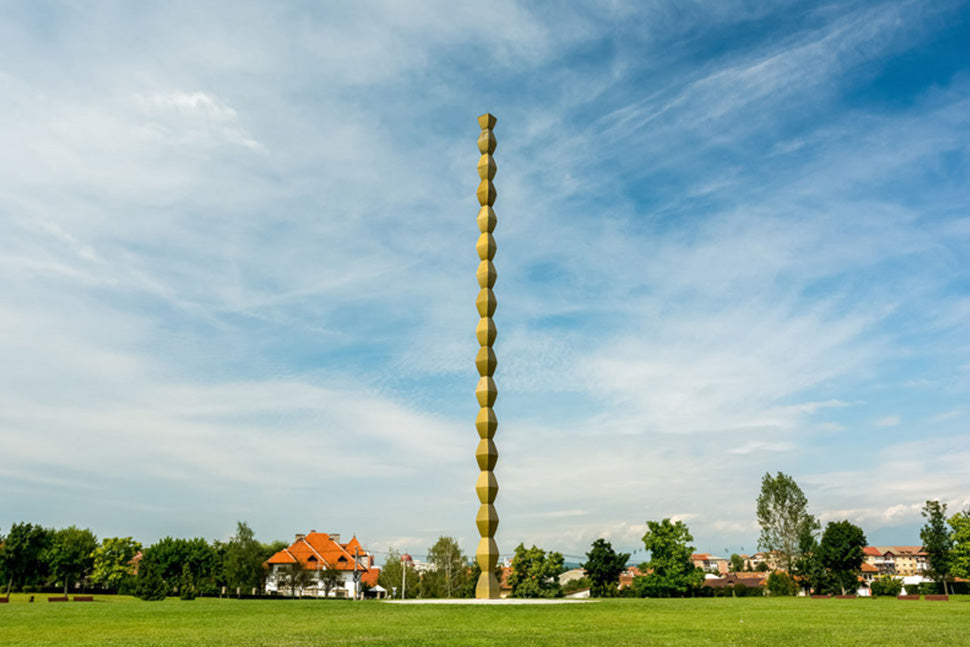
This conceptual maturity is monumentally manifested in the ensemble created in Târgu Jiu between 1937 and 1938. The Table of Silence, The Gate of the Kiss, and The Endless Column are not just commemorative monuments dedicated to the heroes of World War I, but a coherent construction of space and time. The ensemble functions axially, inviting contemplation and passage. The Column, made up of 15 complete rhomboidal modules and two halves, creates the impression of continuous ascent. Philosopher Constantin Noica interpreted this verticality as an "axis of the world," a symbol of continuity between earth and sky. Beyond interpretations, what remains is the mathematical rigor of the proportions and the repetitive clarity of the module, which transforms sculpture into a pure visual rhythm.


His studio in Impasse Ronsin, Paris, represents another dimension of his conception. Brâncuși did not exhibit his works haphazardly; he arranged them with almost architectural precision in relation to natural light. The studio became a coherent organism, a total installation before the term even existed. Today, this space is reconstructed near the Centre Pompidou, offering a rare perspective on how the artist conceived of the work as a whole.
Dissatisfied with how photographers of the time documented his sculptures, Brâncuși learned photography himself and collaborated with artists such as Man Ray. For him, the photographic image was not just reproduction, but controlled interpretation. Photographing the work was part of the artistic process.

His international importance is confirmed by the presence of his works in major collections — including institutions such as the Museum of Modern Art — and by the legal impact of the Brâncuși v. United States case (1928). In this case, an American court recognized the artistic nature of a work from the Bird in Space series, establishing a fundamental precedent for the recognition of abstract art. The decision had consequences for how modernism was perceived and legitimized in the United States.

Parisian Friendships and the Avant-garde Network
In Paris, Brâncuși was not an isolated artist. His studio in Impasse Ronsin became a meeting point for central figures of the avant-garde. He maintained close relationships with artists such as Amedeo Modigliani, Marcel Duchamp, and Fernand Léger, and the dialogue with them was one of ideas, not unilateral influence.
His friendship with Duchamp was particularly important in the context of the reception of his work in the United States. Duchamp supported the presentation of Brâncuși's works in America and was involved in defending them during the customs trial in the 1920s. His Parisian circle also included poets and intellectuals such as Ezra Pound and Guillaume Apollinaire, who contributed to the theoretical articulation of European modernism.

These relationships show that Brâncuși was not a marginal recluse, but a central actor in an international network of artists who redefined the artistic language. However, within this network, he maintained his stylistic autonomy. He belonged neither to Cubism, nor Futurism, nor Surrealism. He remained a distinct voice — a modernist who worked outside manifestos.

Relationship with Peggy Guggenheim
In the international art scene of the 1920s–1930s, Brâncuși came into contact with an influential circle of collectors and supporters of the avant-garde, among whom was Peggy Guggenheim. The American collector, one of the essential figures in promoting modern art in Europe and the United States, appreciated Brâncuși's work and acquired some of his pieces, contributing to his consolidation in important Western collections.

In her memoirs, Guggenheim evokes his paradoxical personality — austere and refined at the same time — emphasizing that for Brâncuși, the relationship with the collector was not strictly commercial. The artist was known for the exacting standards with which he selected his buyers, wanting his works to end up in contexts he deemed appropriate. This attitude confirms a constant of his personality: sculpture was not a market object, but an almost autonomous entity that needed to be protected from simple transactions.
Meeting with Maria Tănase
In 1939, in New York, Brâncuși met Maria Tănase, who was on tour in the United States. The episode is recorded in memoirs and correspondence, and the meeting was later evoked by close associates of both artists.

There are no documents confirming the romantic declarations often attributed to Brâncuși, but it is certain that he was impressed by the strength and authenticity of her expression. The meeting between the two was not just personal, but symbolic: the sculptor who had reduced form to its essence and the singer who had brought Romanian song to major American stages represented two different expressions of the same cultural modernity.

In Brâncuși's case, interest in folklore and archaic structures was never merely decorative.
Brâncuși himself stated: "Do not seek external forms, but the essence of things." This idea is recorded in interviews and testimonies and summarizes his entire direction. He did not pursue fidelity to appearance, but fidelity to principle. In this difference lies his revolution.

Thus, Brâncuși's contribution cannot be reduced to a recognizable style or a series of iconic forms. It consists of a redefinition of sculpture as a language of essence, proportion, and formal silence. Through him, volume became idea, surface became light, and matter became a carrier of conceptual meaning. His influence spans the entire 20th century and continues to shape contemporary sculptural discourse.


Written by Artiss Gallery