
Georgeta Năpăruș
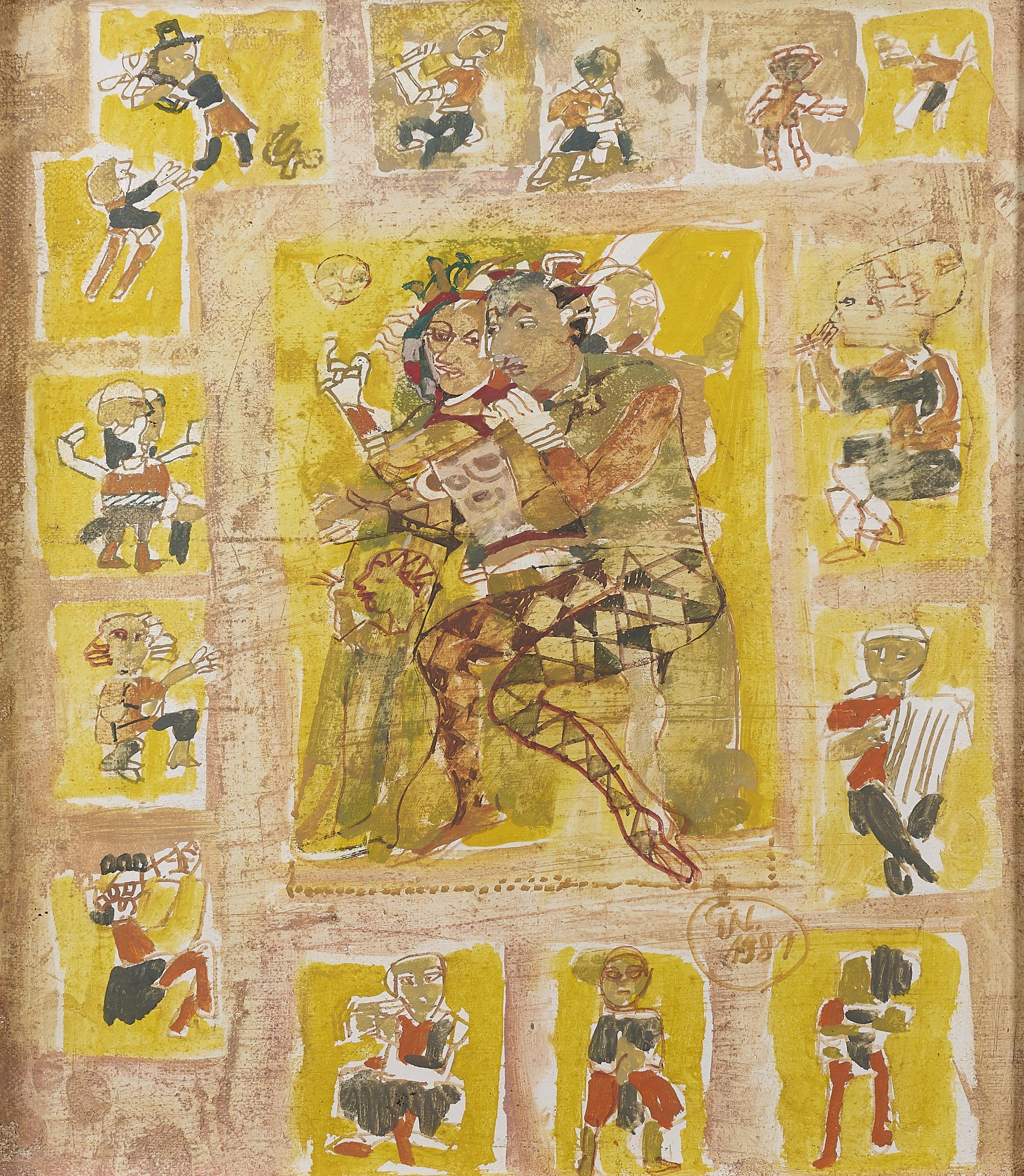
Georgeta Năpăruș (1930–1997) is one of the most poetic and recognizable voices in post-war Romanian painting. A graduate of the "Nicolae Grigorescu" Institute of Fine Arts in Bucharest, the artist developed a personal language where the world of fairy tales, folk symbols, and medieval heraldry meets a refined, modern sensibility. Her palette – intense, yet tactfully harmonized – supports frontal, decorative compositions, populated by royal figures, rural characters, birds, horses, angels, or masks, all arranged within a clear pictorial architecture.
Georgeta Năpăruș's painting lies at the boundary between the naive and the cultivated, between the cult of line and the voluptuousness of color. Motifs derived from Byzantine iconography, traditional textiles and embroideries, and peasant mythologies are reconfigured into her own alphabet: crowns, hearts, sun wheels, leaves, medallions, ornamental grids. The human figure is essentialized, hieratic, accompanied by signs that function as markers of a secret narrative. In parallel with painting, the artist also worked in graphic arts and tapestry, transferring the same decorative discipline into various techniques.
Beyond their decorative charm, her works possess a discreet spiritual vibration: a liturgy of colors where innocence and gravity coexist. The rhythm of the surfaces, the balance between fullness and emptiness, the modulation of warm colors with cool accents give the paintings a slow inner time, conducive to contemplation.
Today, Georgeta Năpăruș is regarded as a benchmark of lyrical Romanian modernity: an artist who united popular memory with contemporary sensibility, creating a world immediately recognizable through sign, rhythm, and light – a visual poetry that remains current and profoundly captivating.
Sort by
1 product