
Sandu Darie – from European avant-garde to Cuban Concrete Art
In the history of 20th-century art, there are artists whose work cannot be confined to a single cultural space or artistic movement. Sandu Darie is one such creator whose biographical and artistic journey intertwines with the major cultural shifts of the era. Born in Romania and intellectually shaped in interwar Europe, Darie would go on to become one of the essential figures of modern Cuban art and a leading promoter of geometric abstraction and kinetic art in Latin America.
His move to Cuba in 1941 was not merely a biographical episode but a moment of profound reconfiguration. His arrival on the island coincided with a period of cultural effervescence, where artists sought a new, autonomous language, capable of transcending traditional figurative art and connecting with international modernist trends.

Source: WikiArt
The Making of an Autodidact Artist
Paradoxically, Sandu Darie did not begin his professional career in fine arts. In 1926, upon arriving in Paris, he pursued university studies in law. However, direct contact with the Parisian art scene, with avant-garde magazines, exhibitions, and intellectual debates of the time, gradually drew him towards art. Without a classical academic training in painting or sculpture, Darie built himself as an autodidact artist, absorbing influences and gradually refining his own visual language.
During this period, he collaborated with progressive magazines and newspapers in Romania and France, producing drawings with a humorous and satirical bent. These works, seemingly peripheral to his later oeuvre, already demonstrated his interest in structure, rhythm, and visual economy – elements that would become central to his later abstract creations.
Cuba and International Recognition
Arriving in Cuba after enlisting as a volunteer in the French army in 1940, Sandu Darie began to publish and exhibit drawings that quickly gained recognition. By 1942, his name was already associated with the island's artistic avant-garde. However, the decisive step occurred in 1949, with his first exhibition in New York. This moment marked his entry into an international art circuit and an opening to dialogue with artists concerned with geometric abstraction and new relationships between form, space, and movement.
It was also then that he began his collaboration with Gyula Kosice, the founder of the Arte Madí group, an avant-garde nucleus that promoted non-figurative art, the autonomous object, and the transcendence of the traditional painting frame. Through this connection, Sandu Darie joined a movement that viewed art as an open system, built on mathematical, geometric, and perceptual relationships.


Sandu Darie - Estructura transformable, ca. 1956, Museo Nacional de Bellas Artes de La Habana


Sandu Darie - Abstracción, 1955, Museo Nacional de Bellas Artes de La Habana
Los Diez Pintores Concretos and Cuban Concretism
Between 1958 and 1961, Sandu Darie was a member of Los Diez Pintores Concretos, one of the most important concrete art movements in Cuba. The group advocated for pure geometric abstraction, rejecting symbolism, narrative, and figurative reference. For Darie, this period was one of synthesis: his European experience, the influences of Neoplasticism, and his interest in spatiality coalesced into a mature plastic language.


Sandu Darie - Pintura transformable, 1957, Museo Nacional de Bellas Artes de La Habana


Sandu Darie - Sin titulo, 1948, Museo Nacional de Bellas Artes de La Habana


Sandu Darie - Construcción visual, ca. 1952, Museo Nacional de Bellas Artes de La Habana
His participation in the São Paulo Biennial in 1953 had already confirmed the international visibility of his art. Within these exhibitions and collaborations, Darie decisively contributed to positioning modern Cuban art in a global dialogue, alongside concrete movements in Argentina, Uruguay, and Brazil.


Sandu Darie - Composición n°. 2. Twentieth Century in mid-passage, 1950, Museo Nacional de Bellas Artes de La Habana


Sandu Darie - Multivisión espacial, 1955, Museo Nacional de Bellas Artes de La Habana
Visual Language: Geometry, Color, Structure
Sandu Darie's works are characterized by clear formal rigor. Primary colors, vertical and horizontal lines, and balanced compositions allude to the tradition of European Neoplasticism. Piet Mondrian's influence is evident, but Darie does not imitate; rather, he adapts these principles within his own context, more open to dynamism and transformation.
An eloquent example is the work "Composition with Red and Black", where the tension between the two colors is organized into a precise, yet not rigid, geometric structure. The relationship between planes creates a visual rhythm that simultaneously suggests movement and balance.

Sandu Darie - Geometric composition in red and black
The same structural logic is found in "Geometric Composition in Red and Black II", a work that illustrates the artist's interest in seriality and variation. It is not about mechanical repetition, but about exploring the possibilities of a geometric structure in relation to the pictorial space.

Sandu Darie - Geometric Composition in Red and Black II
Transformable Structures and Kinetic Art
In the 1950s, Sandu Darie began working on what he called "Transformable Structures." These works mark an essential stage in his evolution, paving the way for a personal kineticism. The pictorial plane is no longer a mere support, but becomes a starting point for mobile elements, axes, and spatial relationships that change according to the viewer's position.
The work "Transformable Structures IV" is representative of this direction. Geometry is not fixed, but is activated through perception and interaction, inviting the viewer to participate in the visual construction of the work. In this sense, Darie transcends the boundary between painting and sculpture, proposing an art of relationships and movement.

Sandu Darie - Transformable Structures IV
This concern for space and verticality is also visible in "Columna espacial", a work that synthesizes the artist's interest in architectural forms and in integrating art into the urban environment – a direction he would explore more intensely in the 1970s.

Sandu Darie - Columna espacial
Recognition and Legacy
Throughout his life, Sandu Darie exhibited in the United States, Cuba, France, the Netherlands, and Japan. His works are now in important public and private collections, including the Museum of Modern Art in New York and the Royal Academy of Fine Arts in The Hague. The distinctions he received, such as the Honorable Mention of the Salón de Pintura y Escultura del Museo Nacional de Bellas Artes de La Habana (1956) or his appointment as Honorary Member of the Royal Academy in The Hague (1975), confirm his status as a major 20th-century artist.


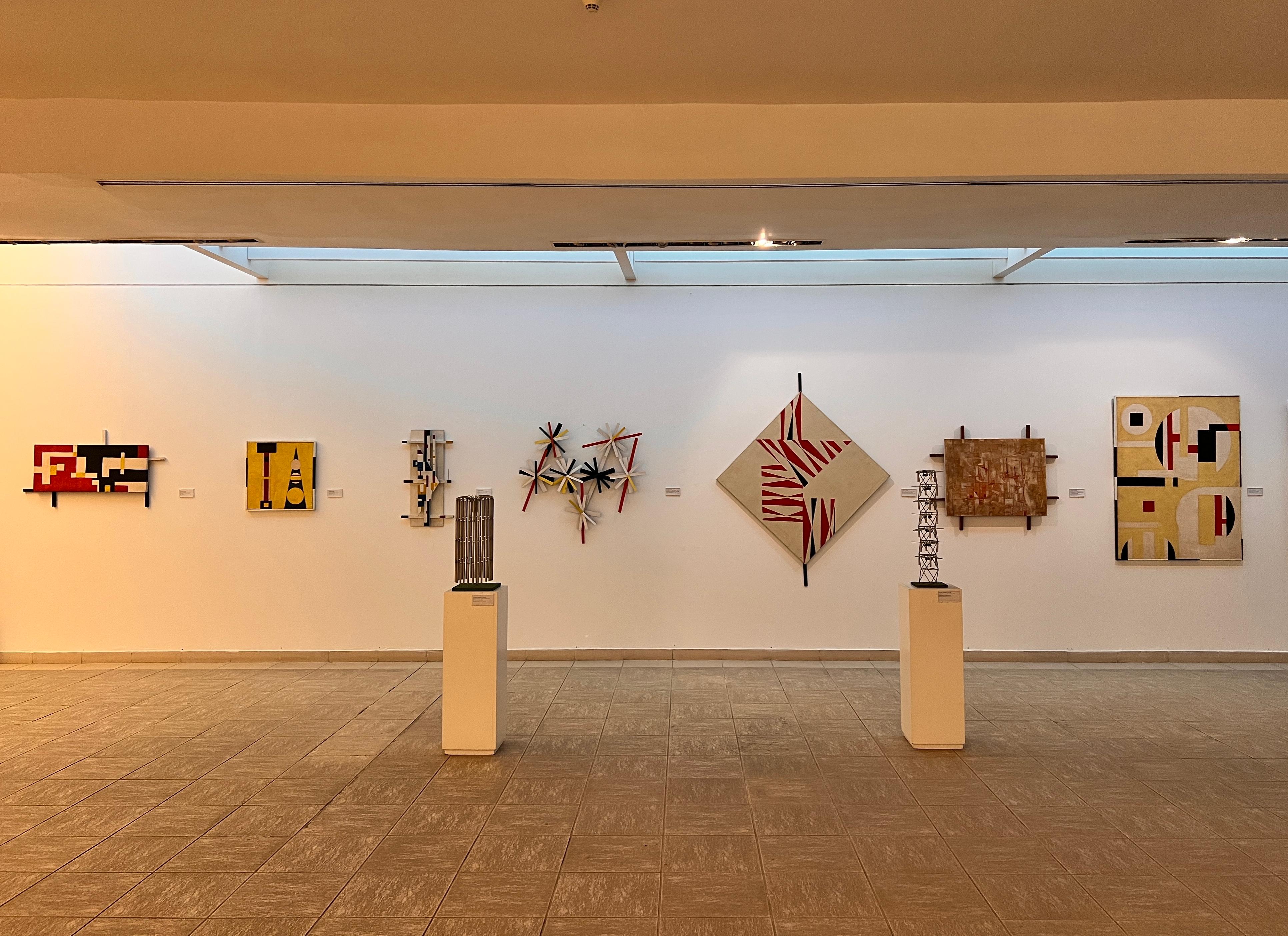
Sandu Darie - Museo Nacional de Bellas Artes de La Habana
Sandu Darie's work is also held in the collections of the Museo Nacional de Bellas Artes de La Habana, one of the most important cultural institutions in Cuba and Latin America. The presence of his works in the museum's heritage confirms the central role Sandu Darie played in the development of modern Cuban art, especially in the affirmation of geometric abstraction and kinetic art in the second half of the 20th century. This institutional recognition places Darie's work not only in an international context but also at the core of Cuban artistic history, as an integral part of Havana's cultural heritage.
Today, Sandu Darie's oeuvre is being rediscovered and re-evaluated within the broader context of international modernism. His works are not just aesthetic objects but testimonies to a way of thinking about art as structure, system, and perceptual experience.
For Artiss Gallery, Sandu Darie represents not only an important name in the history of modern art but a benchmark for collectors interested in geometric abstraction, kinetic art, and the dialogue between Europe and Latin America.

Written by Artiss Gallery