
Romania's Gold Coins (1866–1945) - History, Art, and Investment
Context: Why Gold Matters in Romanian Numismatics
Between 1866 and 1945, Romania transitioned from a Principality to a Kingdom, experienced the Great Union and two World Wars. Gold coins capture these transformations with technical standards comparable to the Latin Monetary Union: 900‰ fineness, stable weights, and easily verifiable diameters — details that made Romanian gold internationally recognizable. Through their design, they feature royal portraits, heraldry, and jubilee or commemorative messages.
Carol I (Prince 1866–1881, King 1881–1914)
20 lei 1868 — pattern type, the symbolic beginning of Romanian gold coinage
Although the first current gold issues are dated 1870 and then the "caroline" series 1883–1890, the symbolic beginning of the 20 lei denomination is linked to the 1868 piece, considered in specialized literature as a pattern / presentation piece (non-circulating). It is made of 900‰ gold, weighing around 6.45 g and with a diameter of approx. 21 mm, respecting the parameters that would later establish the "carolin". The obverse features the bust of Carol I as Prince, and the reverse indicates the value and the year 1868. Due to its ceremonial nature, the piece is extremely rare on the market and appears sporadically in international auctions, where it attracts major interest from advanced collectors. For a consistent collection guide, 1868 is treated as a reference pattern, chronologically followed by 20 lei 1870 and the regular issues from 1883–1890.

The first gold benchmark: 20 lei 1870 (Prince)
- Typical parameters: 900‰ gold, ~6.4516 g, ~21 mm; bust with the legend "CAROL I DOMNUL ROMANIEI"; reverse with value in wreath. The piece is a one-year type, sought after for its foundational status in Romanian gold coinage.

The classic "caroline" series: 20 lei 1883–1890 (King)
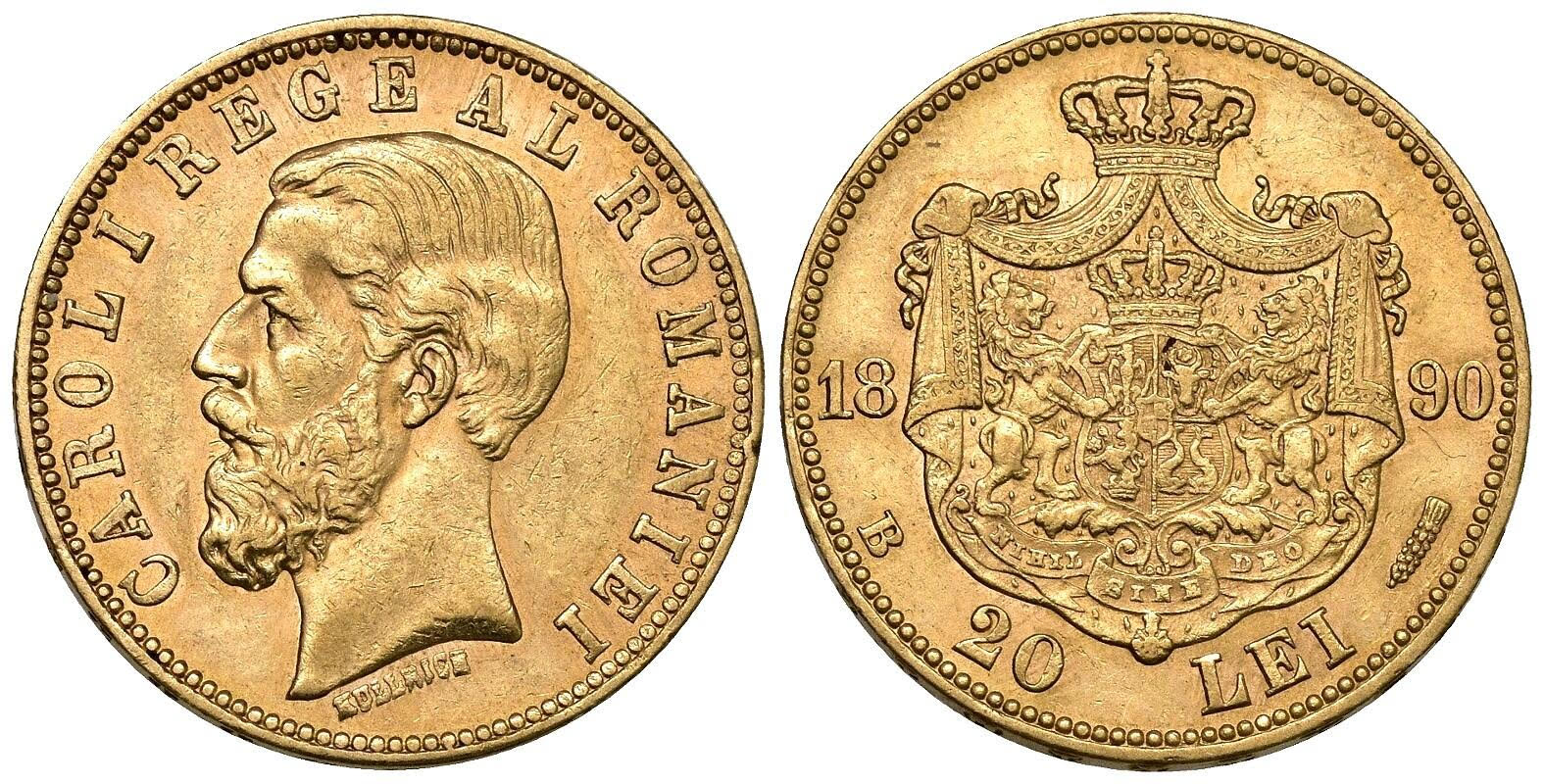
- Parameters: 900‰ gold, 6.4516 g, 21 mm; portrait of Carol I as king; reverse with coat of arms in mantle. This is the most internationally recognized type; differences in condition (VF/EF/UNC) strongly influence its value.
Coin 20 Lei 1883, Carol I King of Romania, gold


40th Anniversary of Reign (1906): an extensive gold program
In 1906, the state marked 40 years since Carol I's ascension with a jubilee series of remarkable artistic quality (engraver Alfons Michaux). Several denominations appeared in gold, all with 900‰ fineness:
-
12½ lei 1906 — ~4.0325 g, ~19 mm; small type, rarely found in very good condition.

- 20 lei 1906 — jubilee type dedicated to the commemorative year; continues the tradition of ~6.45 g weight.

-
25 lei 1906 — ~8.065 g, ~30 mm; one of the most compositionally balanced.

-
50 lei 1906 — ~16.13 g, ~35 mm; equestrian reverse, with strong visual impact.

-
100 lei 1906 — ~32.26 g, ~36 mm; prestigious issue, with a small mintage (≈3,000 pieces), today a benchmark piece in advanced collections.

Collector's note: The 1906 series has numerous legend details, engraver's initials, and alignment differences; technical sheets and specialized literature help authenticate and distinguish variants.
Ferdinand I (1914–1927)
"Coronation" Gold Series (1922): 20, 25, 50 and 100 lei — Ferdinand I & Queen Marie
In the context of the coronation of King Ferdinand I and Queen Marie in Alba Iulia (October 15, 1922), Romania issued an anniversary gold series, designed with high artistic standards and coherent royal iconography. The series brings together four denominations — 20, 25, 50, and 100 lei — and is appreciated for the quality of its engraving, compositional balance, and very clear relationship between weight, fineness, and diameter (useful for verification and comparison). All pieces are 900‰ gold.
20 lei 1922 — the "classic" benchmark of the series
-
Technical parameters: ~6.4516 g, ~21 mm, Au 900‰, reeded edge.
-
Design & engraving: neoclassical royal portrait (attributed to Paul-Marcel Dammann), with the ample legends typical of the period; reverse with the value and year 1922 in a clear, easy-to-read composition.
-
Why it matters: it is the "standard format" (the classic weight of the Romanian "pol"), so many collectors begin the 1922 series with this piece. There are often noticeable differences in field presence and relief between weakly struck and well-struck specimens — a detail that strongly influences valuation in higher grades.

25 lei 1922 — compact type, with above-average visual impact
-
Parameters: ~8.065 g, ~30 mm, Au 900‰, reeded edge.
-
Design: balanced composition, with a successful alternation between portrait, legend, and the coat of arms on the reverse; the piece has "presence" in hand, despite its moderate weight.
-
In collection: sought after in higher grades for its often clean surface and excellent legibility of small details (initials, heraldic elements).

50 lei 1922 — large format, "warm" relief
-
Parameters: ~16.129 g, ~40 mm, Au 900‰, reeded edge.
-
Design: the large diameter highlights the modeling of the portraits and heraldry; in many specimens, the reliefs may appear slightly "flat" in the high areas — a type particularity, not necessarily wear.
-
In collection: a spectacular "on display" piece, ideal for anchoring a 1922 set in a display case.

100 lei 1922 — the prestigious issue
-
Parameters: ~32.258 g, ~35 mm, Au 900‰, smooth edge.
-
Design: the large coat of arms on the reverse and the imposing royal portrait on the obverse give the piece a pronounced ceremonial character.
-
In collection: its relative rarity on the market and its "weight" in gold make it a natural target for advanced collections; it appears periodically in international auctions.

Carol II (1930–1940)
The year 1939 brings the anniversary gold series dedicated to the centenary of Carol I's birth, as well as pieces for the 10th anniversary of Carol II's reign. It should be noted that these issues are non-circulating and very rare on the market.
-
20 lei 1939 — "Centenary of Carol I's Birth"
900‰ gold, ~6.45 g, ~21 mm; small mintage type, with specific relief.

-
20 lei 1939 and 1940 — "10th Anniversary of Carol II's Reign"
900‰ gold, ~6.5 g; non-circulating commemorative series, rarely offered to the public.


-
There are also 100 lei 1939 pieces with anniversary themes, extremely rare in gold; they appear periodically in international auctions, where they are hotly contested.
-
100 lei 1939 — "Centenary of Carol I's Birth".
Parameters: ~32.5 g, ~35 mm, Au 900‰


The "Galbeni" of 1939 – Centenary of Carol I (medallic gold pieces)
"Great Galben" – 12 ducats, 1939 ("Coat of Arms" type)
Metal & parameters: 900‰ gold, ~42 g, ~41 mm, reeded edge.

"Great Galben" – 12 ducats, 1939 ("Reaper" type)
Metal & parameters: 900‰ gold, ~42 g, ~41 mm, reeded edge.

Michael I (1940–1947)
20 lei 1944 — "Our Transylvania / Kings of Romania"
One of the most emblematic late appearances is the 20 lei 1944 in 900‰ gold (~6.55 g, ~21 mm), also known in specialized literature as the "Kings of Romania" or "Our Transylvania" type.
The jubilee coin-medal is dedicated to the liberation of Transylvania and is highly valued by collectors focused on historical messages.
Unlike other modern Romanian and foreign coins, no nominal value was engraved on this piece. Due to the inflation prevalent at the time, it was considered pointless to engrave a nominal value.

Timeline (approximate)
-
1868: 20 lei (pattern, Au 900‰) — the symbolic debut of the gold denomination under Carol I.
-
1870: 20 lei gold (Prince) — the first important current type of modern Romania.
-
1883–1890: 20 lei gold (King) — the classic "carolin", the standard of 6.4516 g / ~21 mm.
-
1906: jubilee gold series — 12½, 20, 25, 50, 100 lei (Au 900‰), dedicated to 40 years since Carol I's ascension.
-
1922: "Coronation" series (Ferdinand I & Queen Marie), Au 900‰:
-
20 lei — the "classic" format (~6.45 g);
-
25 lei — compact type (8.065 g, 30 mm);
-
50 lei — large format (16.129 g, 40 mm);
-
100 lei — the prestigious issue (32.258 g, 35 mm; smooth edge).
(Note: struck with the date 1922, but executed in 1928 at the Royal Mint, non-circulating.)
-
-
1939: 100 lei gold "Centenary of Carol I's Birth" — rare commemorative type; in parallel, medallic gold pieces ("ducats") for the Centenary appeared, with equestrian iconography and heraldic/agricultural motifs.
-
1939–1940: 20 lei commemorative gold ("Centenary Carol I" / "10 years of Carol II's reign") — non-circulating issues, rarely encountered.
1944: 20 lei gold "Kings of Romania / Our Transylvania" (Michael I) — with the motto NIHIL SINE DEO on the edge.
Conclusion
Romanian gold coins from 1866–1945 offer a compact "map" of modern history: from the first 20 lei of the Prince (1868) to the sumptuous jubilee issues of 1906, up to the symbol-rich commemorative issues from 1922, 1939–1944. For collectors, they combine technical legibility (900‰ standard and established weights) with a reference iconography. This guide can serve as a framework: you choose a classic benchmark (20 lei 1883–1890), add a 1906 jubilee for expressiveness, and track, over time, key events (
Romanian gold coins from 1866–1945 offer a compact "map" of modern history: from the first 20 lei of the Prince (1868) to the sumptuous jubilee issues of 1906, up to the symbol-rich commemorative issues from 1922, 1939–1944. For collectors, they combine technical legibility (900‰ standard and established weights) with a reference iconography. This guide can serve as a framework: you choose a classic benchmark (20 lei 1883–1890), add a 1906 jubilee for expressiveness, and track, over time, key events (

Written by Artiss Gallery