
Theodor Aman - Engraver of Romanian Modernity and Architect of a New Cultural Sensibility
In the twilight of his studio on Clemenței Street (now C.A. Rosetti) in Bucharest, a Neo-Gothic building designed according to his own plans, Theodor Aman (1831–1899) orchestrated one of the most profound structural reforms in Romanian visual culture. Although art historiography has often placed him in collective memory as the official painter of the modern state's founding events and as the founder of the School of Fine Arts, his role as an original engraver represents the most technical, experimental, and European element of his entire career. The transition from the status of a reproductive craft to a major, autonomous art form was achieved in Romania exclusively through his graphic work. In a period when the Romanian Principalities sought synchronization with Western cultural forms, the aquatint technique became for Aman an instrument of aesthetic research coupled with a profound documentary and political consciousness. The analysis of his engraved work, visible today through Artiss selections, offers a rigorous perspective on how French academic rigor was grafted onto an autochthonous identity program, leaving a structural legacy for generations of 20th-century graphic artists.

Geopolitical and Cultural Context
Structural Synchronism in an Emerging State
To accurately assess the pioneering value of Theodor Aman's graphic work, it is essential to correlate it with the geopolitical dynamics of Romania in the second half of the 19th century. The historical context is defined by the collapse of old feudal structures of Oriental-Phanariote origin and the acceleration of the national emancipation process. The period between the 1848 Revolution, the Union of the Principalities under Alexandru Ioan Cuza in 1859, and the achievement of State Independence in 1877 imposed an unprecedented effort of institutional construction on the Romanian intelligentsia.
Culturally, this era was marked by what the critic and aesthetician Titu Maiorescu theorized as the phenomenon of "forms without substance." Romania was heavily importing Western legal, political, and cultural institutions without yet having a critical mass of specialists or an educated public capable of organically assimilating them. In this fragmented landscape, the plastic arts had a dual function, both political and pedagogical. They had to rapidly deliver a national iconography capable of legitimizing the newly unified state and, simultaneously, to educate the taste of an emerging bourgeoisie whose aesthetic benchmarks were still precarious.
Aman, trained in Paris in the studios of masters Michel Martin Drolling and François-Édouard Picot, returned to his country animated by the spirit of the artist's full social responsibility. He understood that synchronizing with the West could not be reduced to merely copying styles, but required the creation of a robust institutional apparatus. Thus, in 1864, he obtained the princely decree for the establishment of the School of Fine Arts in Bucharest, which he would lead as director and professor of painting for almost three decades. However, while at the Academy Aman taught the strict rules of anatomical drawing and historical composition, in his private studio he developed an avant-garde technical activity, focused on assimilating interpretative engraving.

The Aquatint Technique as a Modern Aesthetic Option
The introduction of original metal engraving in Romania is directly linked to Aman's Parisian experience in the 1850s. The artist was a direct witness to the movement known as the "Etching Revival" (Renaissance de l'eau-forte), a phenomenon reacting against industrialization and commercial reproductive engraving. The founding in 1862 of the Société des Aquafortistes by publisher Alfred Cadart, a movement joined by artists such as Édouard Manet, James Whistler, and Charles-François Daubigny, demonstrated that the copper plate could be used as a spontaneous medium of expression, similar to direct drawing.
Before Aman, graphic art in the Romanian Principalities had an eminently utilitarian character. Lithography was practiced for press illustration or crude woodcut in monastic centers for religious prints. Aman rejected these rapid multiplication techniques and opted for etching (acid engraving on metal) and, occasionally, burin engraving, processes that required a complex technical infrastructure and almost scientific rigor. He imported a special mechanical roller engraving press from Paris and set up a private metallurgical laboratory in his studio.

The technical process applied by Aman involved stages of microscopic precision. The copper or zinc plate was perfectly polished, degreased, and covered with a thin layer of protective lacquer based on wax and bitumen. With the help of a steel needle, the artist traced the drawing by scratching the wax layer, exposing the metal underneath without directly cutting it. The critical stage was the biting (corrosion): the plate was submerged in a bath of nitric acid (eau-forte), which attacked exclusively the lines exposed by the needle. Aman excelled in the technique of successive bitings. He removed the plate from the acid, covered the fine lines that needed to remain open for printing with a retouching varnish, and reinserted the plate into the bath to deepen the grooves intended for intense shadows. This absolute mastery of chemical and temporal factors allowed him to achieve a range of tones of striking pictoriality, characterized by velvety blacks and fine gray gradations.

Analysis of Thematic Typologies through the Artiss Collection
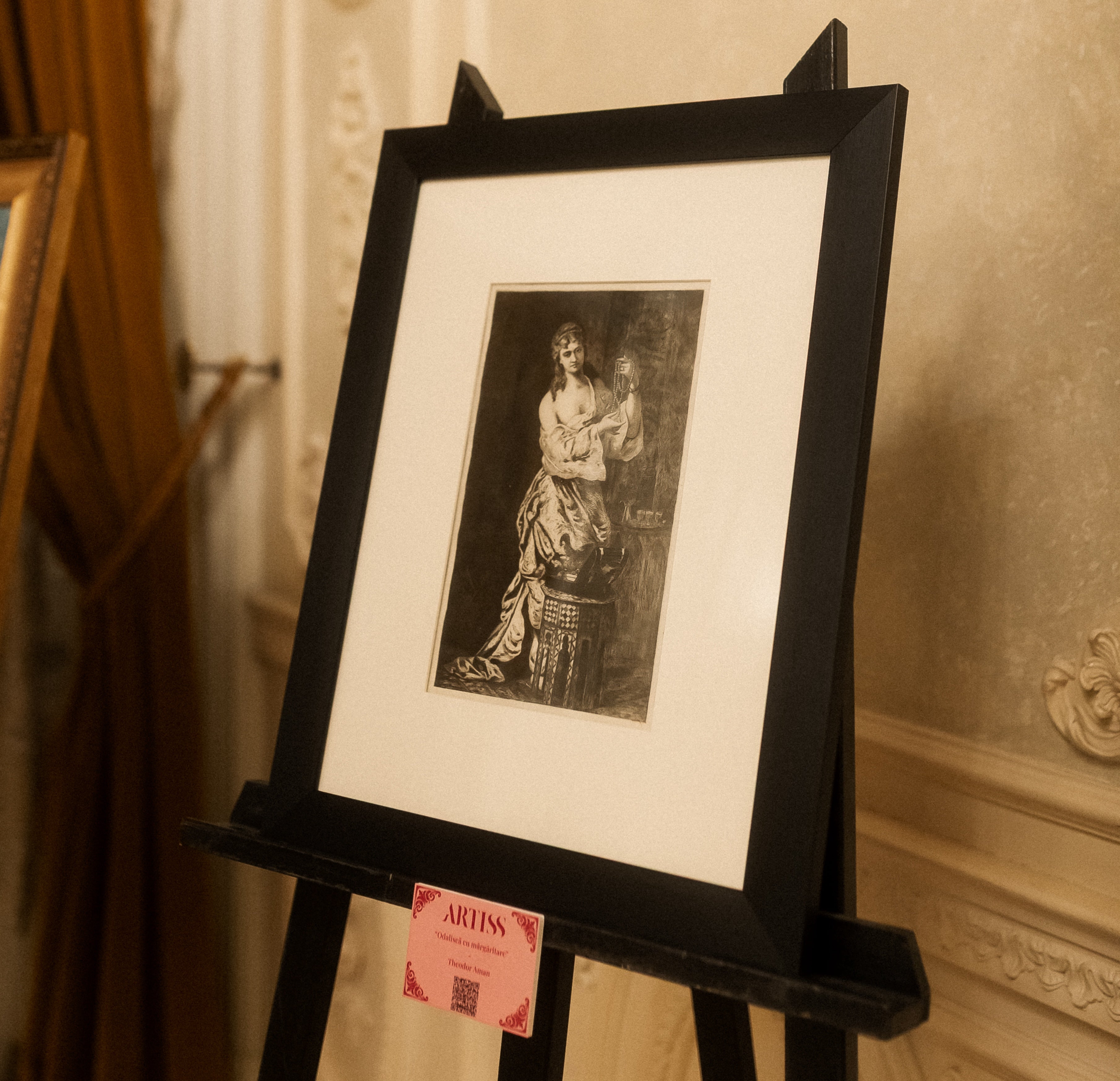
The graphic mastery of Theodor Aman is clearly revealed in the documented examples, pieces that attest to the rigor of period editions and their cultural value. In these prints, the artist operates a synthesis between the obligatory historical theme of the era and a realistic documentation of Romanian social realities.

Historical Composition and Monumental Decantation
In works of historical character, such as portraits of princes or battle scenes, Aman demonstrates a compositional synthesis capacity superior to his monumental paintings. Constrained by the rigors of the small dimensions of the copper plate, the artist eschews secondary decorative details and focuses on essentializing the political message.
His technique is based on the use of a Rembrandt-like chiaroscuro. The backgrounds are constructed from a dense network of crossed hatchings, achieved through deep acid bites, which give the image a dramatic, almost theatrical tension. Light is treated as an accent element: the areas left unprinted (the white of the paper) coincide with elements of symbolic importance – the face of the political leader, elements of armor, or weapon details. These engravings were not mere aesthetic exercises, but cultural propaganda tools intended to circulate in graphic portfolios, accessible to collectors and intellectuals of the time, with the declared aim of consolidating national historical consciousness.

Documentary Realism in Rural Genre Scenes
A comparative analysis of Aman's genre scenes reveals an artist deeply connected to the anthropological reality of the Romanian village. In engravings with rural themes (depicting peasant women spinning, groups of shepherds, or hut interiors), Aman adopts a fundamentally different perspective from that of Nicolae Grigorescu. If Grigorescu imposed a sunny lyricism, idealizing the peasant's condition, Aman remained faithful to an academic realism.
Technically, these works highlight the master's ability to render different textures through pure line. Through subtle modulations of the needle, he suggests the roughness of wool fabrics, the heavy folds of skirts, the asymmetry of wooden beams, and the porosity of earthen walls. The use of a single lateral light source in rural interiors gives these daily scenes a solemn gravity, transforming social reality into a historical document fixed by the rigor of etching.

Portrait as Structural and Psychological Study
In engraved portraits, Aman reaches the peak of his technical maturity. Lacking the chromatic contribution of oil paint, he relies exclusively on the constructive value of the line. His portraits and self-portraits constitute fundamental study material for understanding his anatomical rigor.

In his self-portraits, Aman employs a conceptually mixed technique, where the face is finely modeled through microscopic parallel hatchings that follow the bony and muscular volumes of the face, generating perfect three-dimensionality. In contrast, clothing and background elements are treated with a technical freedom that betrays a knowledge of modern pre-impressionist currents; the lines become long, confident, rapidly sketched, leaving the composition open. A specific technical detail of Aman's portraits is the management of the light point in the pupil. By preserving a millimeter fragment of paper from the incidence of ink, he achieves a wet reflection effect that gives the characters an extremely intense psychological presence.

Cultural and Structural Influence on Future Generations
The legacy left by Theodor Aman goes beyond the documentary and aesthetic value of his own engraved plates; it configured the architecture of modern Romanian graphic art. By professionalizing the discipline and establishing rigorous technical standards, Aman offered successive generations of artists a model of autonomy in graphic language.
The synchronization of Romanian graphic art with major European techniques allowed for black and white art to become a fertile ground for modernism at the beginning of the 20th century. His influence was transmitted through several channels:
- Academic and technical lineage (Gabriel Popescu): The most important heir to Aman's technical rigor was Gabriel Popescu (1866–1928), the first Romanian engraver trained at the Parisian engraving school under the guidance of Jules Jacquet. Popescu adopted Aman's absolute rigor in metal execution, becoming the professor of the engraving class at the School of Fine Arts in Bucharest and refining the techniques of burin and etching to a level of microscopic precision.
- Expressiveness of autonomous line (Iosif Iser and Jean Alexandru Steriadi): Prominent artists of the interwar period, although aligned with avant-garde or expressionist aesthetics, retained Aman's cult for incisive, structural drawing. Iosif Iser used the Amanian legacy of rigorous composition to demonstrate that black and firm lines could express the entire dramatic weight of a composition without resorting to chromatic illusionism.

Re-evaluating Aman's Work through Contemporary Collecting
In the current Romanian art market, Theodor Aman's graphic work is undergoing a legitimate process of critical re-evaluation. For a long time considered secondary to his oil paintings, his original engravings are now recognized as the authentic core of his artistic thought.
Investing in an original engraving by Theodor Aman represents an act of recovering the foundations of Romanian modernity. In an era saturated with digitally multiplied images, Aman's aquatint remains a benchmark of technical excellence, a material testament to the moment when Romanian fine art definitively adopted the professional and conceptual rigors of Western Europe.

Written by Artiss Gallery