

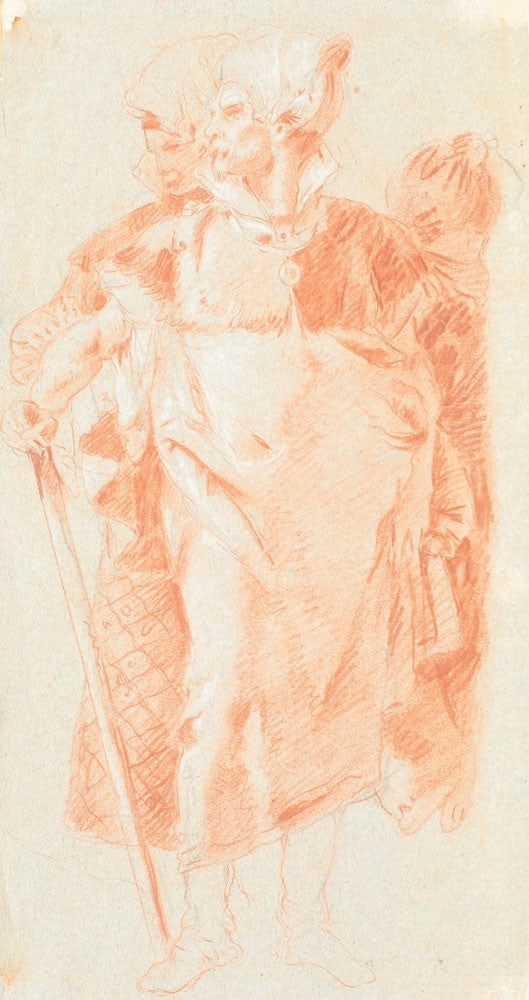
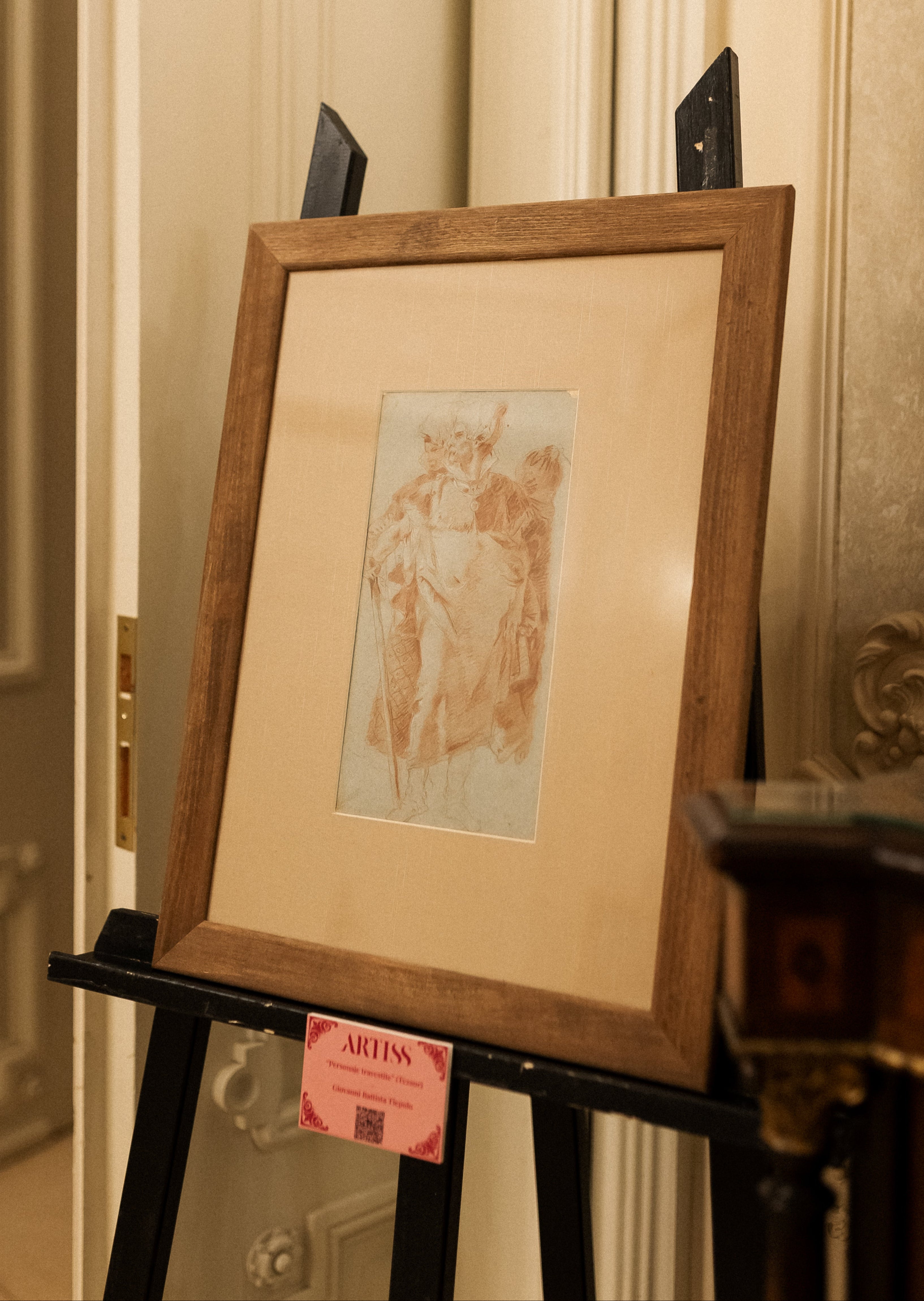
Giovanni Battista Tiepolo - Figures in Costume (Treasure)
sanguine and white chalk on grey paper with watermark - Lily Flower
29.5 × 16 cm
DOCUMENTARY DATA
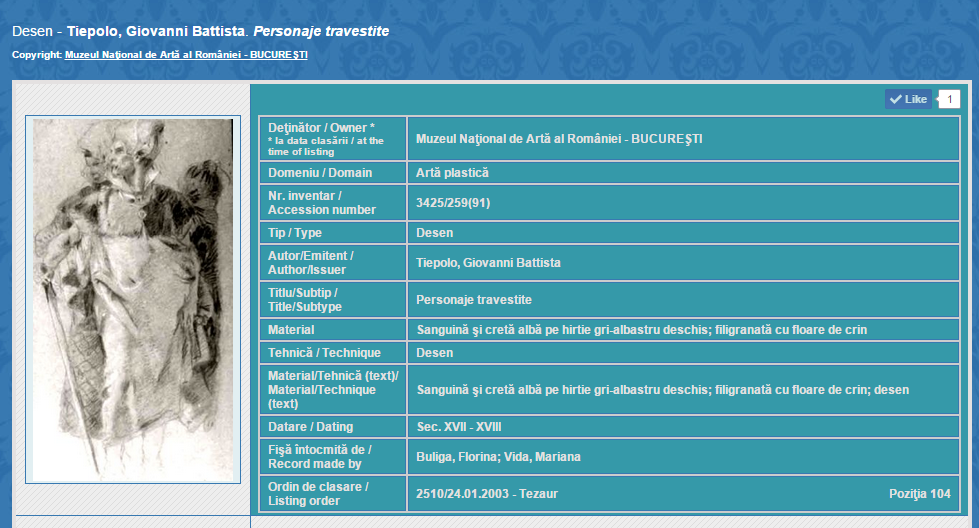
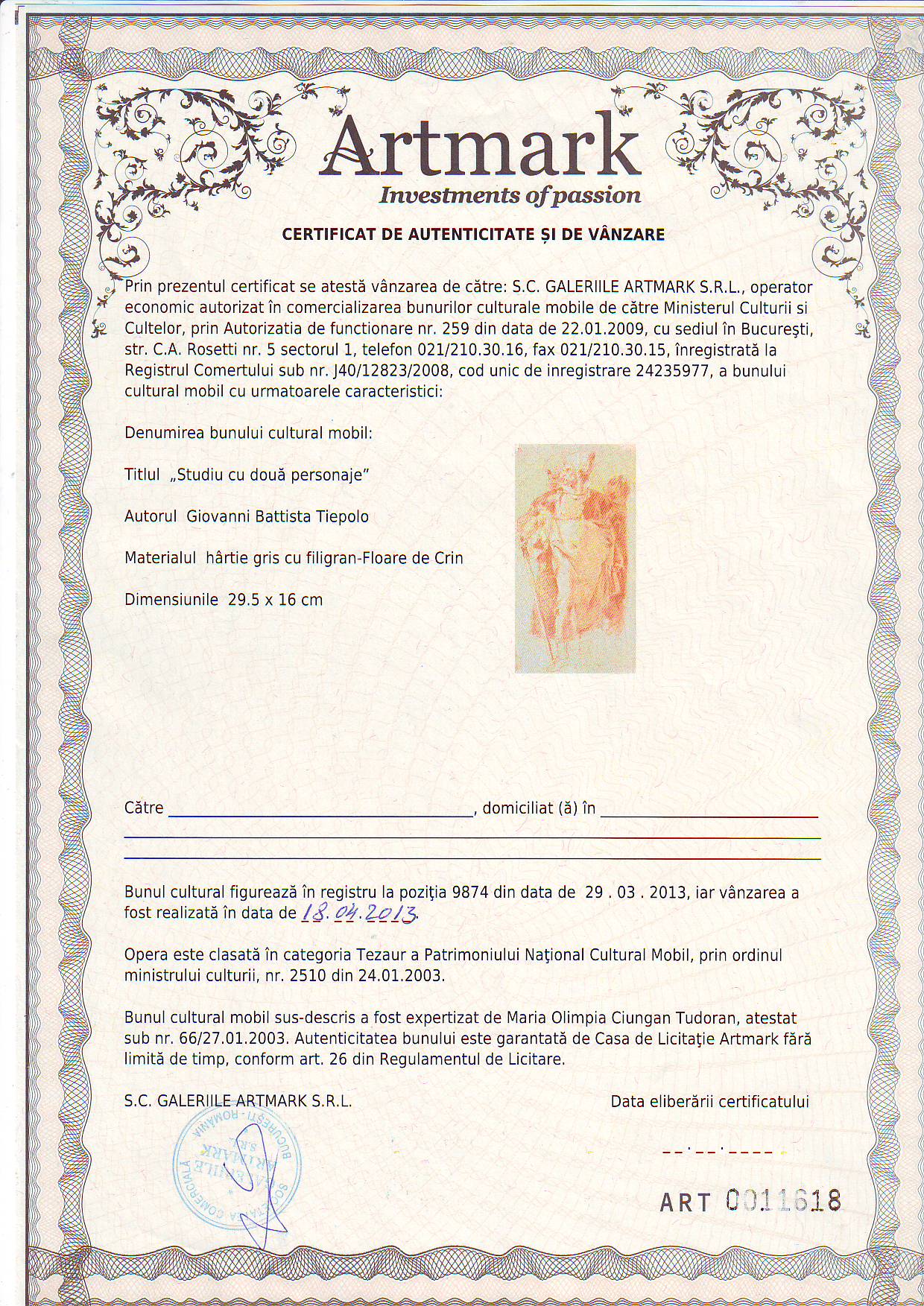
The work is classified in the Thesaurus category of the National Movable Cultural Heritage, by order of the Minister of Culture, no. 2510 of 24.01.2024.
PROVENANCE
- Artmark Bucharest, acquired in 2020, with Certificate of Authenticity.
-
Collection of Romanian diplomat Vasile Stoica, collection taken over in 1977 by the National Museum of Art of Romania, and after the fall of the communist regime, restituted to the diplomat's heirs in 2009.
Inventory no. 3425/259/91 Art Museum of Romania.
Expertise report drawn up by expert Dr. Cătălina Macovei, head of the Print Cabinet, Library of the Romanian Academy.
ABOUT TIEPOLO
The Venetian Giovanni Battista Tiepolo (1696-1770) undoubtedly represents one of the most important artists of the 18th century and of Mannerism. His art conveys a theatrical and grandiose image of the ancient world, of myths, and of sacred legends. His first major works are a series of enormous canvases depicting ancient battles, created to decorate the reception hall in Ca’ Dolfin, Venice.
Giovanni Battista Tiepolo is also recognized for the spontaneity and accuracy with which he applied wash on paper, creating vivid, expressive portraits. With an exceptional descriptive capacity, the artist translated the emotions and character of the figures into his sketches, through animated gestures or carefully observed details.
His talent quickly brought him fame; in Italy, he was seen as a magician of wall and vault paintings, and in Padua, he was appointed president of the Academy of Art. Tiepolo was presented everywhere as the ideal expert for monumental, panegyric, and apotheosis scenes, his frescoes also having the quality of being viewable with the same effect from multiple angles.
The present studies are a relevant example of the maturity with which Tiepolo worked in sanguine or white chalk (a technique he began to use more and more frequently from 1740-1743). These figures, looking into the distance, appear to be, by their attire, from the Venetian nobility. Beginning with quick and simple applications of sanguine, the artist outlines the shadows, which he deepens and makes vibrant by applying white chalk to the edges of the forms.
Giovanni Battista Tiepolo is also recognized for the spontaneity and accuracy with which he applied wash on paper, creating vivid, expressive portraits. With an exceptional descriptive capacity, the artist translated the emotions and character of the figures into his sketches, through animated gestures or carefully observed details.
His talent quickly brought him fame; in Italy, he was seen as a magician of wall and vault paintings, and in Padua, he was appointed president of the Academy of Art. Tiepolo was presented everywhere as the ideal expert for monumental, panegyric, and apotheosis scenes, his frescoes also having the quality of being viewable with the same effect from multiple angles.
The present studies are a relevant example of the maturity with which Tiepolo worked in sanguine or white chalk (a technique he began to use more and more frequently from 1740-1743). These figures, looking into the distance, appear to be, by their attire, from the Venetian nobility. Beginning with quick and simple applications of sanguine, the artist outlines the shadows, which he deepens and makes vibrant by applying white chalk to the edges of the forms.
BIBLIOGRAPHY
ALPERS, Svetlana, BAXANDALL, Michael, Tiepolo and the Pictorial Intelligence, Yale University Press, 1994.
MILLER, Arthur, The Drawings of Tiepolo (Master draughtsman series), Borden Publications, 1956.
CRISTANTE, Cristina Donazzolo, GRANSINIGH, Vania, Giambattista Tiepolo, tra scherzo e capriccio, Electa, 2010.
MAZZOCCA, Fernando, MORANDOTTI, Alessandro, Tiepolo - Venezia, Milano, l'Europa, Gallerie d'Italia - Skira, 2020.
Giovanni Battista Tiepolo - Figures in Costume (Treasure)
Sale price50.000,00 lei
Choose options
Giovanni Battista Tiepolo - Figures in Costume (Treasure)
Sale price50.000,00 lei