

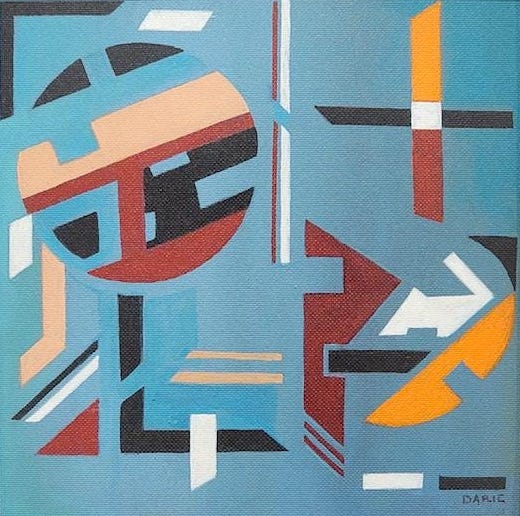
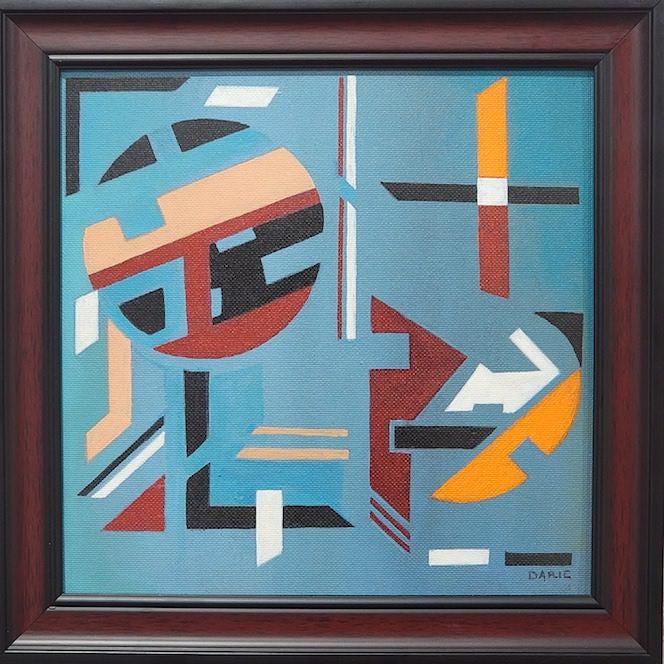
Sandu Darie - Transformable Structures II
signed lower right
oil on plywood
36 x 36 cm
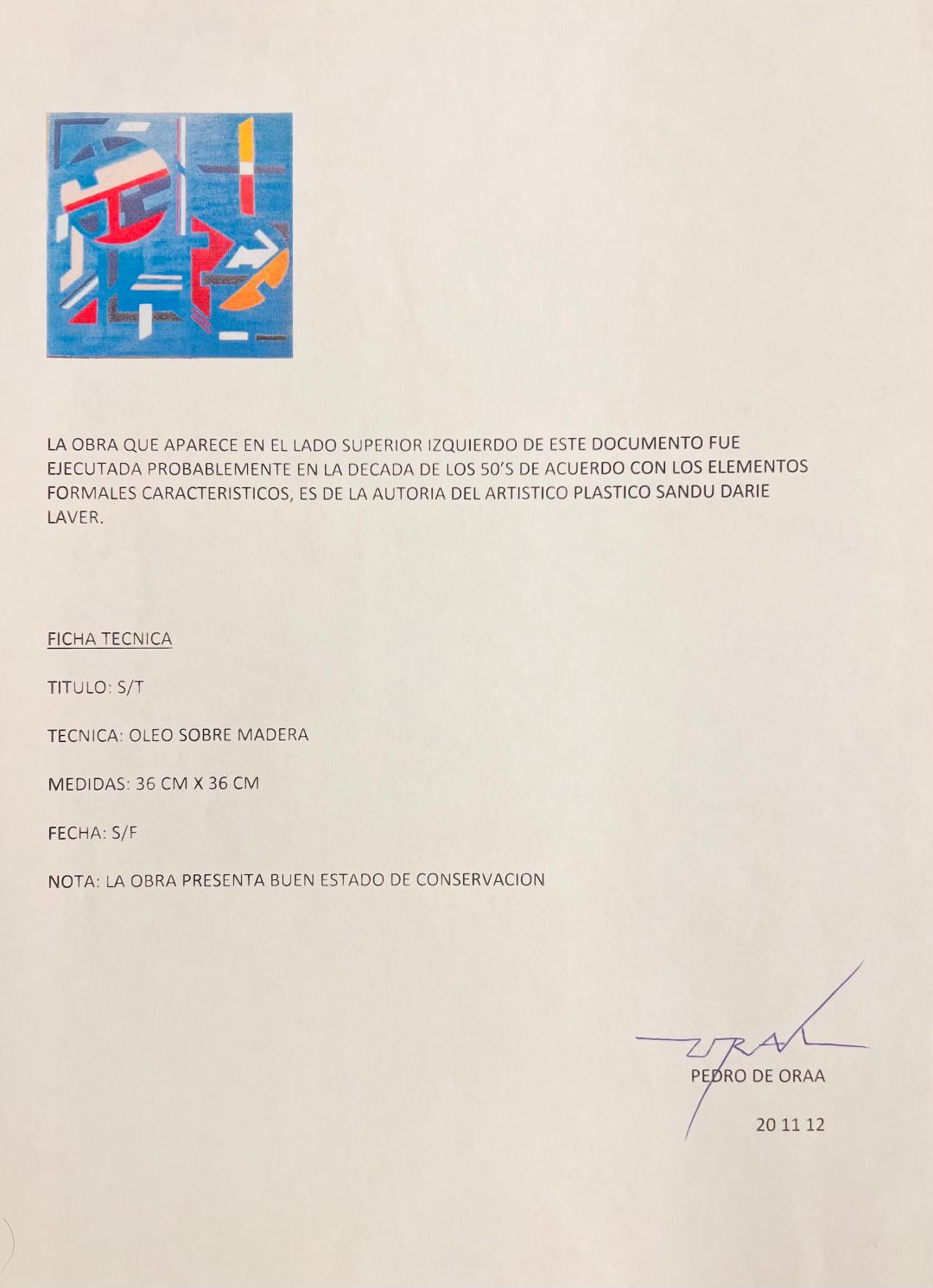
The work is accompanied by a Certificate of Authenticity issued by Pedro de Oraá on 12.11.2012
DOCUMENTARY DATA
In the 1950s, Sandu Darie began working on what he called "Transformable Structures". These works penetrated a personal kineticism, where the pictorial plane acts as a base from which mobile axes for the viewer are born. A multidisciplinary artist, he worked in different artistic fields, including sculpture, painting, drawing, ceramics, scenography, and theatre costumes. He began his academic training in Paris in 1926 in the university field of law. However, his interest in art and the artistic atmosphere in Paris introduced Sandu Darie to the world of art in a self-taught manner. During this period, the artist combined his training in France with participation in progressive magazines and newspapers in Romania and France, in which he produced humorous drawings. In 1940 he joined the French army as a volunteer, arriving in Cuba a year later. On the island, he began to produce humorous drawings, which gained him a great reputation, making him a leading artist from 1942 onwards. In 1949, the year of his first exhibition in New York, he began his artistic relationship with Gyula Kosice, the founder of the "Arte Madí" group, and thus became involved in the group's exhibitions and in the publication of articles in the group's magazine. Between 1958 and 1961 he was a member of the renowned artist group "Diez Pintores Concretos", and in 1964 he produced the documentary "Cosmorama. Poema espacial no 1", an experimental study of forms and structures in motion. In the 1970s, his production followed a line of projects for urban architectural environments using kineticism as a language. In 1982 he was a member of the jury of Salón Paisaje'82, Museo Nacional de Bellas Artes, Havana, and in 1988 he was on the jury of the III Salón de Premiados, Museo Nacional de Bellas Artes, Havana, Cuba. Sandu Darie Laver is one of the most remarkable figures in Cuban art. He is one of the main precursors of abstraction in both its lyrical and geometric aspects. An example of his geometric abstraction experience is this plastic work, which, due to its formal and structural characteristics, could have been executed in the 1950s. He was also one of the leading representatives of kinetic art. Among his many recognitions, it is worth mentioning the Honorable Mention of the VIII Salón de Pintura y Escultura del Museo Nacional de Bellas Artes de La Habana in 1956 and his appointment as Honorary Member of the Royal Academy of Fine Arts in The Hague (Netherlands) in 1975, the Museo Nacional Centro de Arte Reina Sofía in Madrid, and numerous private collections around the world, as well as institutions such as the Casa de las Américas in Havana (Cuba) and MoMA in New York, among others.
PROVENANCE
- Dynasty Fine Arts, Miami, USA
Choose options