
Horia Damian – from Bucharest to Paris, a path to monumentality
In a cold February of 1922, Bucharest was a city in full interwar effervescence, with literary cafes, exhibition halls, and a cosmopolitan spirit pulsing through its boulevards. It was into this atmosphere that Horia Damian was born, a man who would become a resonant name in Romanian and universal art, a child for whom destiny had reserved a journey that would take him from early painting to monuments evoking the infinite.

Source: Demarco Digital Archive

Source: Demarco Digital Archive
Young Damian first trained at the School of Architecture in Bucharest, a choice that cultivated his sense of proportion and geometric discipline. But painting irresistibly attracted him. In 1941, at only 19, he debuted at the Official Painting Salon at Dalles Hall, and a year later had his first solo exhibition at the Romanian Athenaeum. The Anastase Simu Distinction for painting, which he received then, confirmed that in front of the critics was not just a promising debutant, but an authentic talent.

Source: Demarco Digital Archive
The moment that would change his life came in 1946, when he obtained a scholarship to Paris. The French capital was at that time a magnet for artists from all over the world. There, Damian came into contact with masters such as André Lhote, Daniel Lager, and Auguste Herbin. Under their influence, and also through the discovery of Mondrian, through Felix del Marle, the young Romanian entered the world of geometric abstraction. It was an intense period, during which he learned, experimented, and sought his path.

Source: Demarco Digital Archive
The 1950s were years of turmoil. Damian created many works but also destroyed a large part of them. He was seeking an expression that truly belonged to him, feeling that he could not merely stick to what the artistic trends of the time dictated. From this restlessness arose the desire to take art beyond the limits of two-dimensionality.
In the 1960s, his direction became clearer. Works such as Constellation (1961) show how Damian used the impasto technique, with dense, almost sculptural layers of color, approaching Tachisme. It was the beginning of a quest for the monumental, a stage where painting seemed to want to escape its own frames. In 1967, with the series Le trône, Damian transformed geometry into a language with spiritual significance. In these works, Damian transcends the boundary between painting and sculpture: his thrones become grandiose constructions, with an air of solemn architecture, carrying an intense spiritual charge.

Source: Radu Varia - Centenary Horia Damian
Critic Pierre Restany remarked that "Damian's work testifies to a burning desire to spiritualize the act of painting. It is neither carried away by impulse nor seeks to provoke." In the artist's hands, precise lines and clear forms did not become cold, but charged with emotion. Damian did not use geometry as a mathematical calculation, but as a language through which transcendence could be achieved.

Source: Radu Varia - Centenary Horia Damian

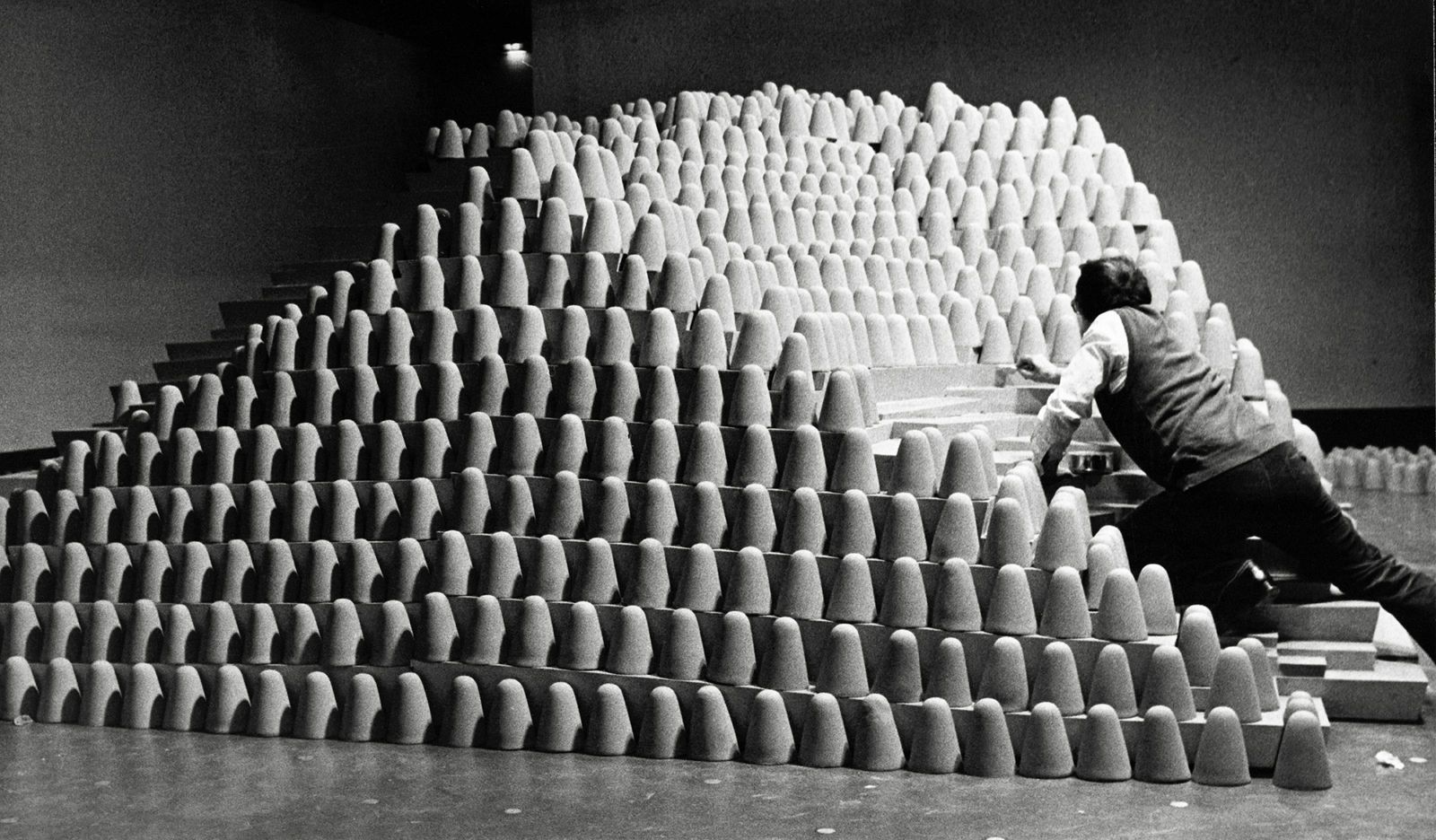
The 1970s were for him a period of international recognition. In 1972, he conceived the first monument in the Galaxie series for Houston, USA. In 1974, the project took shape at the Neue Galerie in Aachen, Germany. At the same time, for the Solomon R. Guggenheim Museum in New York, Damian created La Colline, a monumental work made of polystyrene covered with thousands of yellow paper spheres. It was a universe in itself, a cosmic hill that transformed the museum space into a metaphysical experience.
In parallel, Damian worked on projects such as Projet pour San Francisco, in which gouache became the instrument for future works.

Horia Damian - Le projet de San Francisco
Art critic and historian Radu Varia was one of those who understood and promoted the unique dimension of Damian's work. Thanks to him, the artist exhibited at the Centre Pompidou, Grand Palais, Documenta in Kassel, the Venice Biennale, MoMA in Rio de Janeiro, and many others. Varia published important volumes about his work, such as Galaxie (1974), La Colline (1976), and Métaphysique et monumentalité (1992). Damian thus became not only a recognized artist but a benchmark in contemporary art.

Source: Radu Varia - Centenary Horia Damian

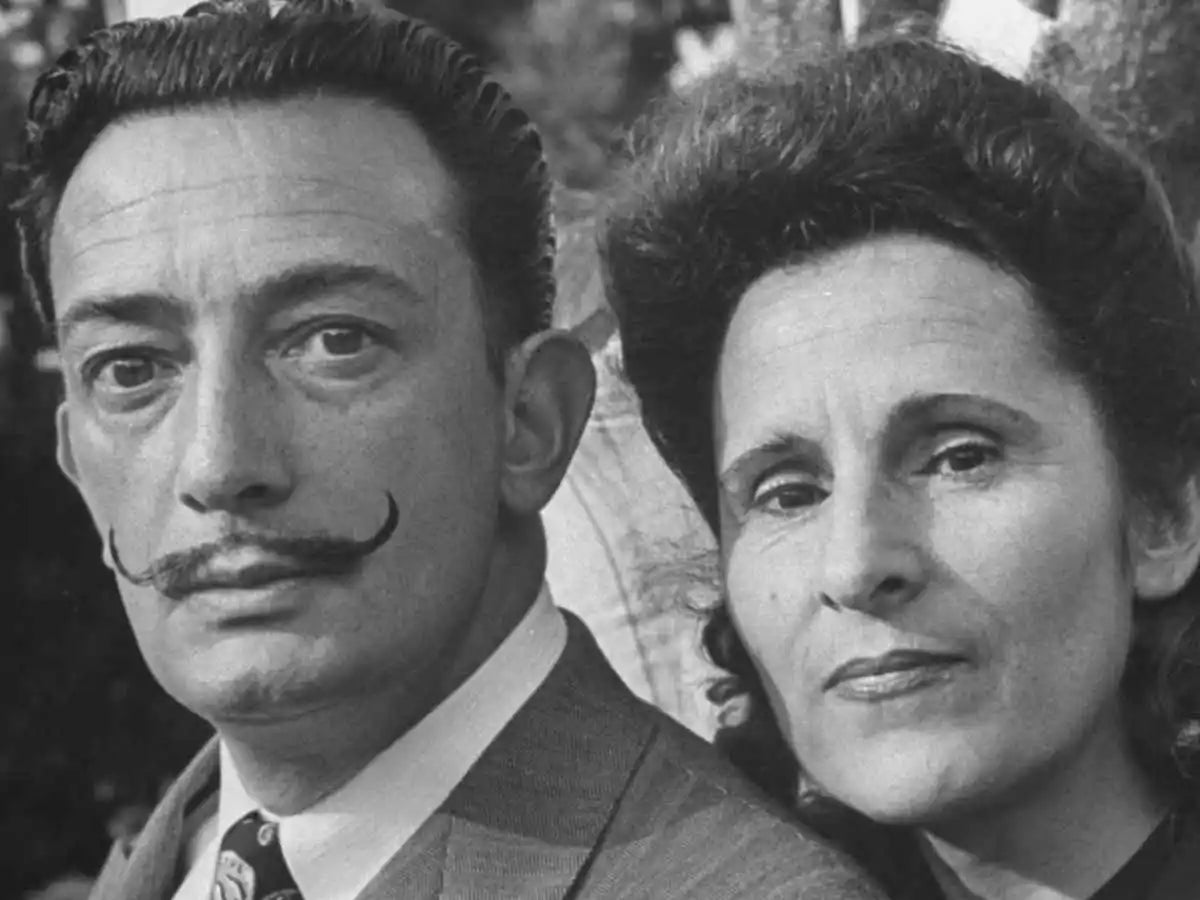
In 1981, UNESCO invited him to participate in an artistic project dedicated to peace, a moment that confirmed his international recognition. However, Horia Damian remained what critics later called 'a great solitary of the twentieth century': an artist who did not join any movement, preferring to follow his own path, thus approaching, by destiny, the figure of Brâncuși. And perhaps that is why Salvador Dalí said: "Damian, the other hero of Romania alongside Brâncuși."

Source: Plan-B Gallery
Today, Damian's works can be admired not only in major museums around the world but also on platforms such as Artiss.ro, where collectors have access to authentic works. Among them are graphic compositions that illustrate the rigor of his style, as well as pictorial pieces with symbolic significance. Looking at them, we discover the same tension between exact geometry and the visual poetry that established him.
His value in the art market is confirmed by spectacular sales. In 2014, at Sotheby's Paris, the work Joueurs de Rugby sold for over $65,000. Other works have traded in recent years for several thousands or tens of thousands of dollars. This constant interest demonstrates that Horia Damian is a name that continues to fascinate collectors and art critics.

Source: Plan-B Gallery
In Romania, the artist was rediscovered through retrospective exhibitions. In 2022, 100 years after his birth, the Romanian Academy organized a comprehensive exhibition, presenting emblematic works and publishing a detailed catalog about his career. The curatorial texts emphasize the universal dimension of his work and invite us to view Damian's creation as a permanent dialogue between art, science, and spirituality.
Overall, Horia Damian's destiny seems to have been that of a visionary. He started in Bucharest, found his voice in Paris, conquered the world's museums, and remained true to his own vision. He did not seek immediate popularity but a path that would leave deep traces over time. That is why today, when we see his works, we feel that we are not just looking at art objects, but windows into another universe. An ordered, geometric universe, yet full of mystery and emotion.

Source: Radu Varia - Centenary Horia Damian
Damian's legacy is immense. Through his works, he demonstrated that art is not just visual expression but also reflection on the human condition. He transformed geometry into a poetic language, made monumentality a meditation on the infinite, and proved that a Romanian artist can be, alongside Brâncuși, a hero of universal art.

Horia Damian - Composition blanche centre rouge

Source: Plan-B Gallery

Source: Radu Varia - Centenary Horia Damian

Written by Artiss Gallery