
Salvador Dalí and Gala: The Surrealist Love That Rewrote 20th-Century Art
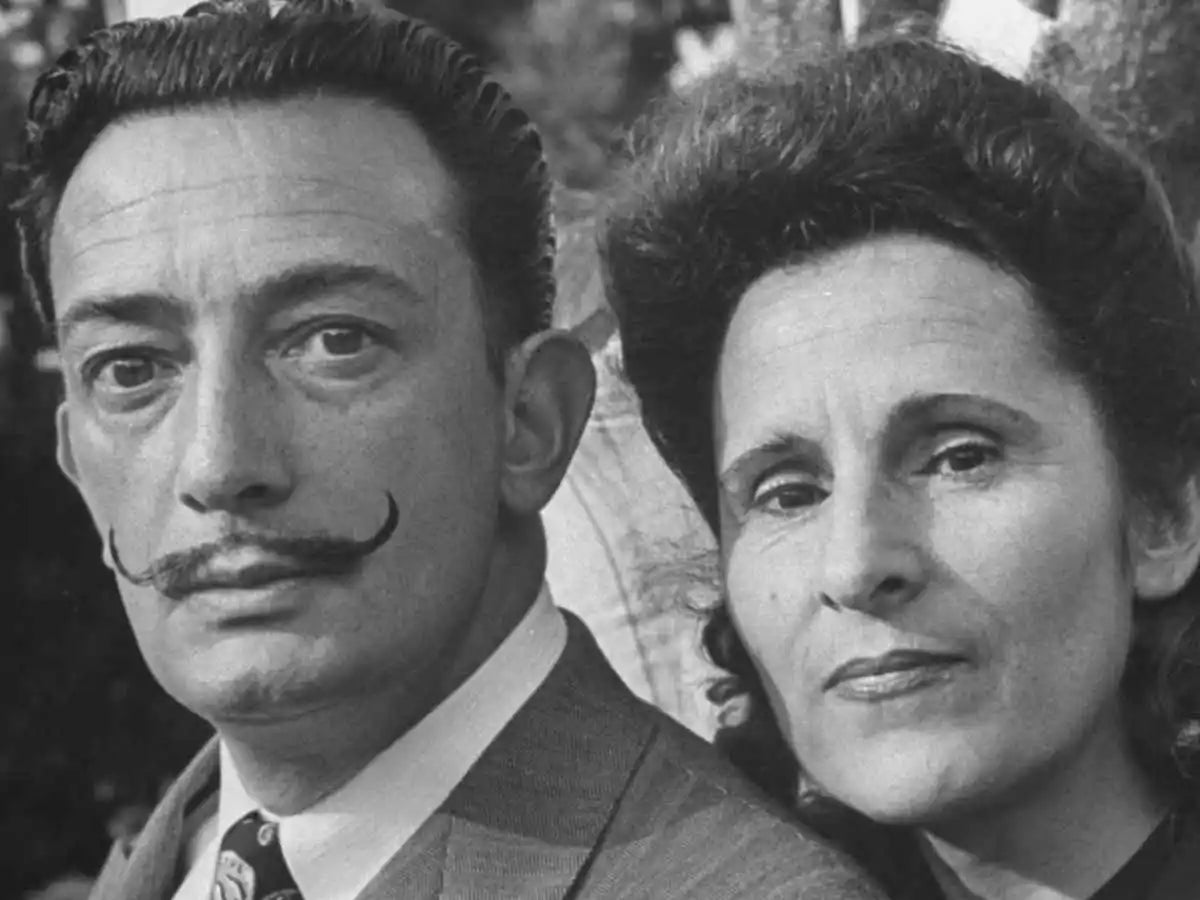
Salvador Dalí's mind seems to have always needed a fixed point – a kind of pole of his subjective world – and this point, from the summer of 1929, bore the name Gala. The encounter in Cadaqués, when Paul Éluard came with his wife to visit the young painter, turned into a kind of epiphany: "She wanted something... something she had begun to believe that only I could give her," Dalí notes in his autobiography. Amidst the sharp rocks and the burning light of the Costa Brava, their meeting extended until the end of September; and after Éluard left, Gala remained in Cadaqués, then went to Paris with Dalí and some of his canvases for an exhibition at Galerie Goemans. From then on, Salvador Dalí's life would be told in the plural.
Before becoming "Gala/Dalí," she had been Elena Diakonova from Kazan: a frail teenager, sent to the Clavadel sanatorium in Switzerland for tuberculosis, where she met the future poet Paul Éluard. They married in 1917, had a daughter, Cécile, and through Éluard, she entered the Dadaist and Surrealist circles of Paris. Gala's biography, from her childhood in Russia to her role in the avant-garde, is sprinkled with discretions and ambiguities, but the underlying force is clear: practical intelligence, an instinct for art, the ability to recognize genius and to organize its destiny.

Source: Artsper Magazine
When Dalí appeared, Gala was not just his muse; she was a critic, manager, strategic partner. The Dalí Museum's timeline shows her taking on, from the 1930s, the management of money and contracts, negotiating with collectors and galleries, choosing primers, paints, varnishes, down to suitable frames. She created the context in which the painter could paint – an "invisible architecture" of their daily lives, without which the Dalí project would not have had the same energy.
In parallel, "Salvador Dalí" was crystallizing his language. Freudian in temperament and curiosity, he formulated his "paranoiac-critical method," a deliberate process of inducing controlled hallucinations to produce "hand-painted photographs of dreams," as summarized by art history and museum sources. This theoretical mechanism nourished "The Persistence of Memory" (1931), where soft watches transformed time into a malleable matter, and the painter – into an emblematic voice of surrealism.

Source: Artsper Magazine
Gala's role in Dalí's recognition within the Surrealist group is explicitly mentioned: with his notes on the paranoiac-critical method, she convinced André Breton that this originality deserved to be absorbed into the movement. Soon, Dalí became the figure who aroused both fascination and scandal – and the signature "Gala-Salvador Dalí" began to appear, as a seal of their symbiosis.
Their civil marriage in 1934, in Paris, legalized a union already visible in all public gestures. In 1936, at the Great Surrealist Exhibition in London, the two appeared together; in the following years, patronage solidified, networks strengthened, and the couple became formidable in influence and visibility. Everything rested on a precise distribution of roles: Dalí envisioned, Gala directed.

Source: Artsper Magazine
The war pushed them to the United States (1940). There, between New York and California, Gala did what she knew best: she managed logistics, protected the studio, stayed close to key people, and secured exhibitions. In 1941-1943, American collectors entered their orbit, and Dalí painted "Galarina" – a portrait of Gala with a penetrating gaze, executed with classical patience, marking a kind of badge of their new transatlantic beginning.
When the war ended, the couple returned to Portlligat (1948), and Dalí's interest in science, space, the atom, along with a religious re-contact, coalesced into a new aesthetic. From this energy was born "Madonna of Port Lligat" (1949), a profoundly personal image: Mary and the child, in an open setting, with suspended elements – and the unmistakable face is Gala's.
"Madonna of Port Lligat" is also a visual landmark, a sign of how Gala's image, filtered through personal sacredness, became a modern icon.

Salvador Dali - Madonna Of Port Lligat

In 1952, Dalí composed "Galatea of the Spheres," a reconfiguration of Gala's bust into floating spheres. The portrait becomes atomized: a plastic metaphor for vibrating matter, for a world where the indivisible is seen, and love acquires geometry. The title refers to myth, the image to physics, and the person – to Gala, once again at the center of the Dalinian cosmos.
And this image – "Galatea to the Spheres," in the version present on Artiss – narratively links two lines: Dalí's passion for science and the permanence of Gala's face in his art. It is not just a presence in his work, but also an emotional trajectory: everything she meant to him ultimately becomes form, rhythm, structure.

Salvador Dali - Galatea to the spheres
Moreover, Gala's name also animates editorial projects that bear her visual signature. "The Wines of Gala" – the whimsical and seductive book about wine – organizes liqueurs according to the sensations they evoke, in such a Dalinian classification, re-released by Taschen in recent editions. It is the playful complement to the iconic refinement of the paintings: the way Dalí put the gastronomy of pleasure on paper, ennobled by Gala.

Salvador Dali - Los vinos de Gala
Between the 1950s and 1960s, Gala and Dalí lived, created, and exhibited themselves. In 1958, they married religiously at the Chapel of the Angels, near Girona. Over time, Gala claimed a room of her own, desired a refuge. In 1969 – some sources indicate 1968 – Dalí bought the castle in Púbol for her, which he restored and painted, giving rise to a strange convention: he could only visit her with a written invitation.
It is not an isolated whim, but rather the expression of that mixture of freedom and control they always practiced. Ziarul Metropolis describes Gala as the perfect "demon woman" for Dalí: hedonistic, pragmatic, mysterious, an art dealer with an infallible instinct; others emphasize her role as muse, manager, and merchant par excellence of Dalí's work. Her gaze remained, in memory, steely but effective – a mechanism between eros and strategy.
If we look back, we see how, at every turn, Gala made room for Dalí to be Dalí. In 1929, she piqued Breton's curiosity for the paranoiac-critical method; in the US, in 1940-41, she kept the house in order and the contracts moving; then, when her face becomes "Galarina" or "Madonna of Port Lligat," we understand that it's not just a portrait, but a private theology.

Source: Artsper Magazine
The career of "Salvador Dalí" is clearly visible through the institutions that mapped his work. The Gala-Salvador Dalí Foundation collects over 4,000 works in its own collection, in museums and homes that tell the story of the couple; exhibitions dedicated to Gala (from Barcelona to Figueres) continue to show that the muse was, in fact, a co-author of the context of meaning.
As for Dalí himself, reference biographies and historical summaries highlight several constants: an interest in dreams and the unconscious (Freud), a taste for scenography and theatrical gestures, a scientific curiosity that pushed him towards images of the atom and sacred geometry after 1945, and, in all of this, a way of transforming obsession into method. All converge in one portrait: the artist-as-spectacle, with a baroque mustache, complemented by a circle of forces that maintained his imaginary machine.

Source: The Paris Review
In 1970-1980, the difficult years – fatigue, illness, emotional distances began to be felt. This period was marked by episodes of suffering, Gala's detachments, her separate relationships; meanwhile, Dalí continued to transform the world into signs. In 1982, Gala died in Portlligat and was buried in Púbol – her sanctuary. It is, perhaps, the most difficult year for Dalí: shortly after, the noble title "Marqués de Dalí de Púbol" consecrated, without intending to console, a union that had just broken.
The following year, 1983, at his wish, the Fundació Gala-Salvador Dalí was created, the institution intended to preserve, protect, and make visible the artistic and intellectual legacy of both of them. Until his death in 1989, Dalí managed the foundation as a final project: the institutional form of a love that fueled his work. After all, without Gala, this museum of his life would not have had the same contours.

Source: Daily Art Magazine
Looking back, you notice how this narrative is not about a genius and his muse, but about a two-geared machine, moving each other. At the end of time, behind the soft clocks, there is a woman who knew how to make cultural energy an economy of meaning; and in front of a woman with an instinct for power and form, there is a man who knew how to transform love into a science of image. There, in that contact zone, are "Madonna of Port Lligat," "Galatea of the Spheres," and even "The Wines of Gala" – different artifacts of the same revelation: that for Salvador Dalí, Gala was not only the face of the painting, but also the mechanism of the world behind it.
These works, together, compose a mirrored self-portrait: Dalí seen through Gala, and Gala seen through Dalí. It is perhaps the most honest way to enter their story – through the works that have survived them.

Source: The Dali

Written by Artiss Gallery