
The great 19th-century gallerists who radically transformed the art market
In the official history of art, the names that shine are those of painters: Monet, Cézanne, Picasso, Renoir, etc. However, if we were to look at that era through the lens of economic and social reality, we would discover that these titans were, to a large extent, the products of a revolutionary 19th-century invention: the art gallery system. Until the middle of that century, the artist was a servant of the state, dependent on the conservative juries of the Official Paris Salon. If you weren't accepted there, your canvases remained hidden, and your name faded into oblivion. But in a Paris undergoing full Haussmannian transformation, a handful of visionaries – people with brilliant commercial instincts and suicidal aesthetic courage – decided to break this monopoly. They were the gallerists Paul Durand-Ruel, Ambroise Vollard, and Daniel-Henry Kahnweiler. They were not merely intermediaries but architects of taste, strategists who transformed the art object from a decorative curiosity into a financial asset and a symbol of modern status.

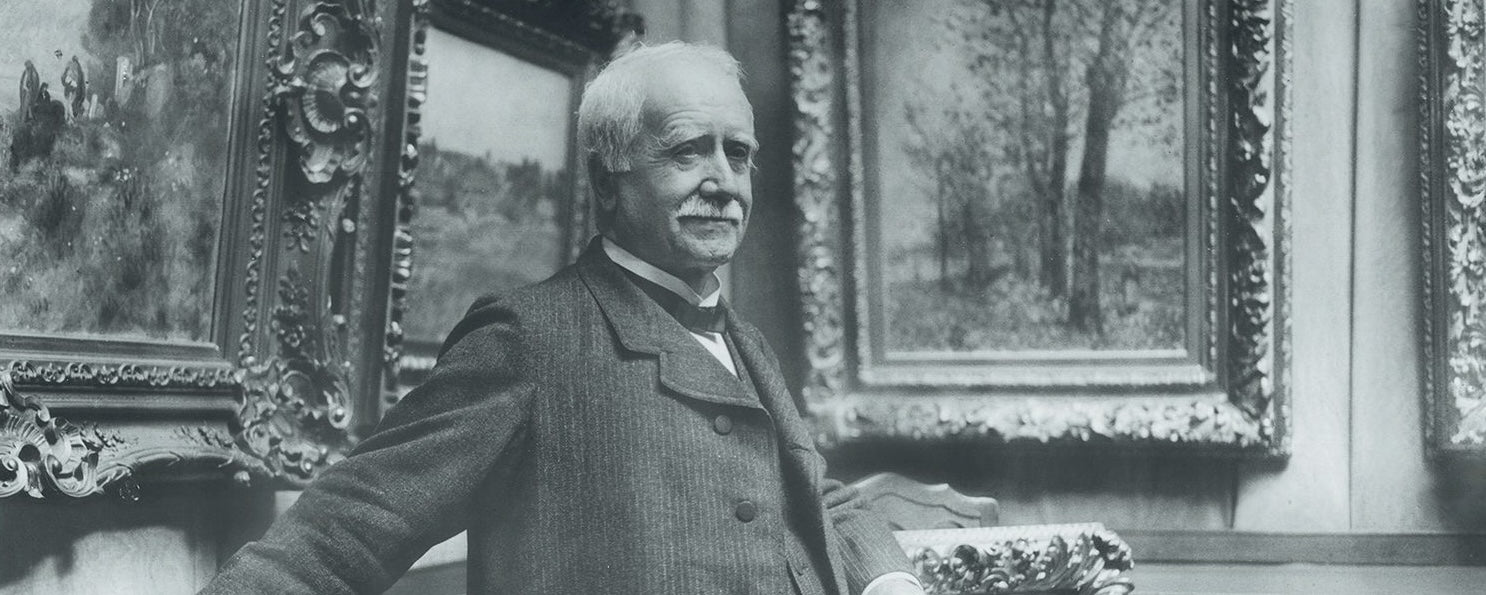
Durand-Ruel and Claude Monet in Giverny, 1900
Paul Durand-Ruel and the Bet on Eternity
The story of the radical transformation of the art market truly begins in the stationery shop on Rue de la Paix, belonging to the Durand-Ruel family. Young Paul initially did not want to be an art dealer; he dreamed of a military career, but fate placed him at the epicenter of an unprecedented aesthetic crisis. In 1870, while Paris was besieged by Prussian troops, Durand-Ruel fled to London, taking a few paintings with him. There, one afternoon that would change the course of history, Charles-François Daubigny introduced him to a poor young painter: Claude Monet.

Durand-Ruel saw in those specks of light and water reflections something the rest of the world called "madness" or "lack of finish." He understood, with an almost prophetic intuition, what art historian Lionello Venturi would describe decades later as "the moment when the eye learned to see again." But Durand-Ruel's genius lay not only in his taste but in the invention of a financial system to support that taste. He was the first to apply the concept of "benevolent monopoly." At a time when artists were starving while waiting for a mention at the Salon, Paul began to buy their entire output. He paid their rent, bought their paints, and offered them a monthly salary, thus transforming the artistic act from a lottery into a protected profession.

His greatest victory, however, was psychological. In 1886, when Paris still mocked the Impressionists, Durand-Ruel risked everything and crossed the Atlantic to New York. Americans, lacking European academic prejudices, saw in Monet, Renoir, and Pissarro the freshness of a new world. "The American public does not laugh; they buy," Durand-Ruel wrote in his memoirs. This was the first globalization of the art market. Through him, Impressionism was no longer just a French movement but a universal currency of prestige. He established the golden rule of the modern gallerist: you don't sell an object; you sell a vision of the world.


Ambroise Vollard and the Cultivation of Mystery
If Durand-Ruel was the elegant diplomat of art, Ambroise Vollard was his fascinating anti-hero. Arriving from Réunion Island, Vollard was a massive, often silent figure who seemed to doze in his small, dark gallery on Rue Laffitte. But behind his half-closed eyelids hid the keenest hunter's instinct in art history.


Vollard understood that value in art arises not only from beauty but also from rarity and "discovery." In 1895, he organized Paul Cézanne's first major exhibition. At that time, Cézanne was a hermit in Aix-en-Provence, almost forgotten by his colleagues. Vollard not only exhibited his works but created a myth around the artist. He understood the mechanism of the "difficult": the harder an artist was for the general public to understand, the more desirable they were for the elite collector.

His relationship with the young Pablo Picasso is a lesson in risk management. In 1901, Vollard offered the Spaniard his first Parisian exhibition. Although the works from the Blue Period were not selling, Vollard felt the raw power of genius and continued to stock works. He invented what we now call "long-term investment in talent." Moreover, Vollard revolutionized the concept of limited edition by publishing artist's books and prints, understanding that a collector who couldn't afford an oil on canvas would proudly buy a signed lithograph.

Daniel-Henry Kahnweiler and Intellectual Rigor
With the turn of the 20th century, the art market demanded something new: theory. This is where Daniel-Henry Kahnweiler comes in, a young German who opened a tiny gallery in 1907. If Durand-Ruel and Vollard worked with intuition, Kahnweiler worked with logic. He was the "architect" of Cubism.

Daniel-Henry Kahnweiler, 1956

Kahnweiler was not just the one who sold Picasso and Braque; he was the one who explained them to the world. In an era when the public saw only "shards of glass" in Cubism, Kahnweiler wrote aesthetic treatises. He understood that avant-garde art needed a solid critical apparatus. He established a fiercely exclusive relationship: his artists were not allowed to exhibit anywhere else. The gallery became an hermetic temple, accessible only to the initiated. This strategy of "deliberate isolation" exponentially increased prices. He wasn't looking for the masses; he was looking for those ten global collectors (from Russia to Germany) who understood that the world had irreversibly changed after Les Demoiselles d'Avignon.


The Legacy of a Lost World
The influence of these men on how we consume culture today is incalculable. Without Durand-Ruel, Monet might have remained a provincial caricaturist. Without Vollard, Cézanne would have permanently retreated into rural anonymity. Without Kahnweiler, Picasso would not have had the necessary platform to trigger the Cubist revolution.
They transformed the art gallery from a mere shop into a laboratory of ideas and a financial engine. Today, galleries like Artiss.ro continue this tradition, adapting their principles to the digital age. Curation, the protection of artistic vision against aggressive commercialism, and the education of the collector remain the pillars upon which the modern art market rests. The 19th century taught us that art needs not only genius to exist but also a handful of courageous people to build it a pedestal in a world that, initially, refuses to see it.


Written by Artiss Gallery